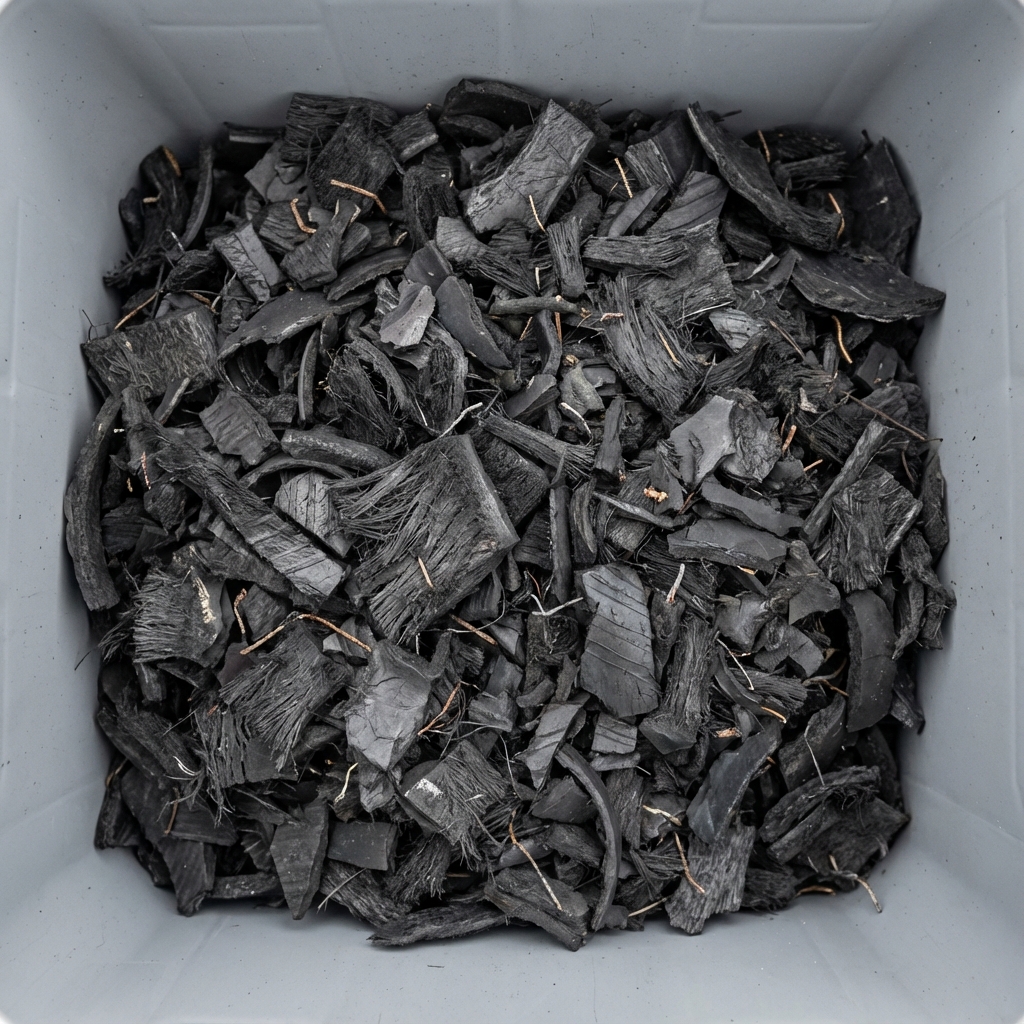
Recycled Tyre Texture
Venture-Stage R&D (TRL 1-2)

Circular Insulation for Social Housing Retrofits

Venture-stage R&D (TRL 1-2) investigating circular-economy materials for high-volume social housing upgrades. Targeting a structural material cost advantage through diverted tyre feedstock. Currently iterating binder formulations and fire retardancy.

55M+ Annual UK Tyre Waste (Feedstock)
B2B Targeting High-Volume Segments
TRL 1-2 Design & Material Selection Phase

About ReTyre

ReTyre is a UK-based circular economy initiative in the pre-validation phase (TRL 1-2). Our mission is to develop a B2B insulation system for contractors and housing associations that utilises diverted waste streams to target a structural reduction in material costs per m³.

The UK Insulation Gap

Current models force a choice between affordability and the environment.

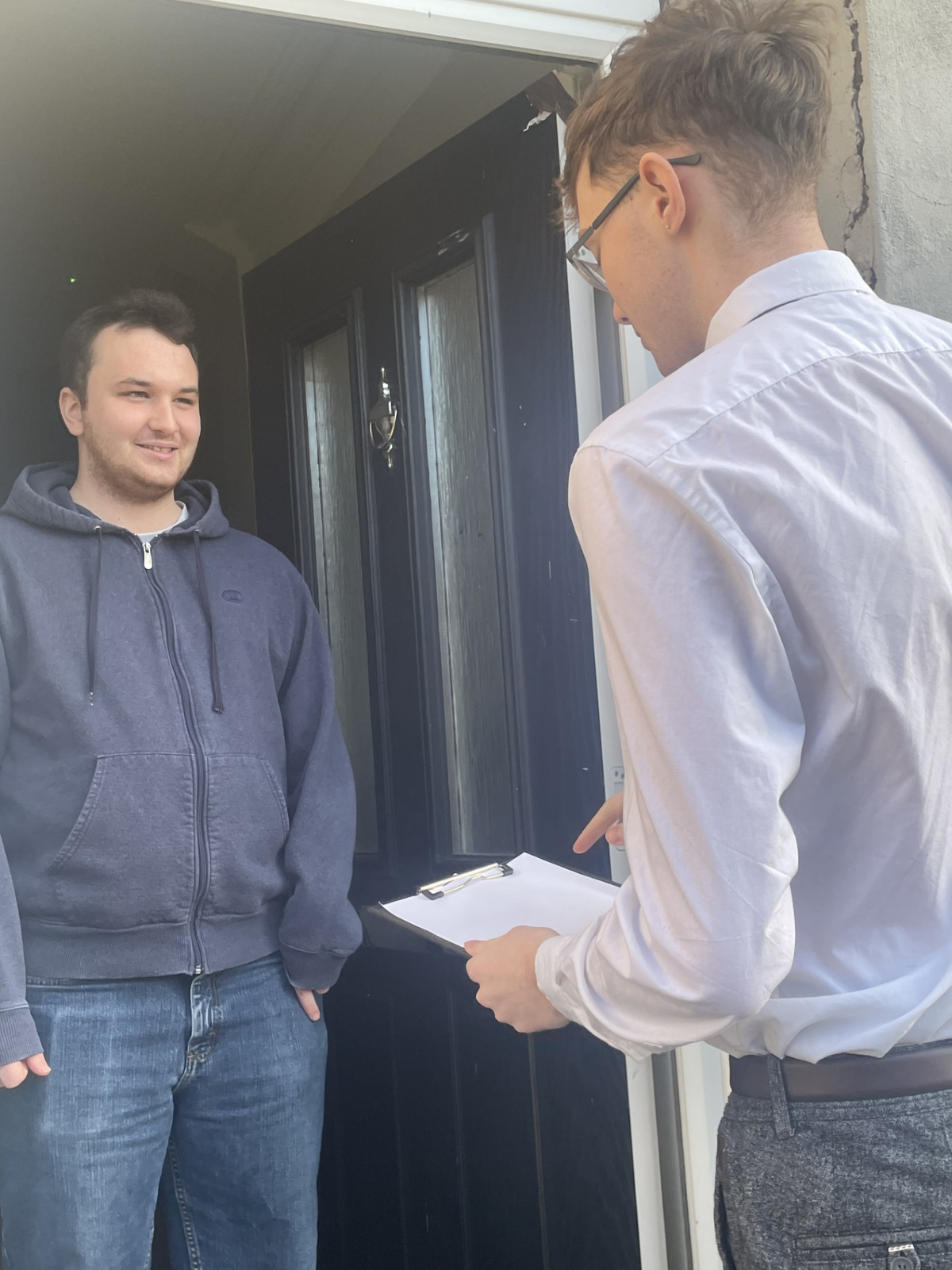
Nathaniel surveying property
Preliminary Market Research

University of Leeds Research

Source: Enterprise Coursework Survey (2025)

  • Market Appetite: High percentage of surveyed homeowners willing to adopt recycled alternatives if cost-performance parity is met.
  • Demand Driver: Significant dissatisfaction with current insulation costs and installation complexity in low-medium income households.

Commercial Barriers

High material costs in traditional insulation lead to extended payback periods, slowing the rate of social housing retrofits and energy efficiency upgrades.

Feedstock Waste

The UK generates over 55 million end-of-life tyres annually. Current disposal methods include landfilling and export, representing a massive loss of material value.

Housing Inefficiency

Inefficient housing stock disproportionately increases maintenance costs for local councils. There is a clear market need for scalable, low-cost thermal solutions.

Technical Objectives

ReTyre is investigating a multi-component material system using tyre crumb and mineral binders to solve the cost-sustainability trade-off in insulation.

  • Material Logic: Investigating a composite of Crumb Rubber (recycled mass) and Mineral Binders (Sodium Silicate/Calcium Carbonate) for non-toxic fire retardancy and structural cohesion.
  • Unit Architecture: Encapsulation within fire-retardant Geotextile to ensure material integrity and integration with standard construction wall cavities.
  • Non-Validated Status (TRL 1-2): Thermal conductivity targets (~0.05 W/m·K) and fire safety ratings (Euroclass objectives) are currently hypotheses awaiting primary lab validation.
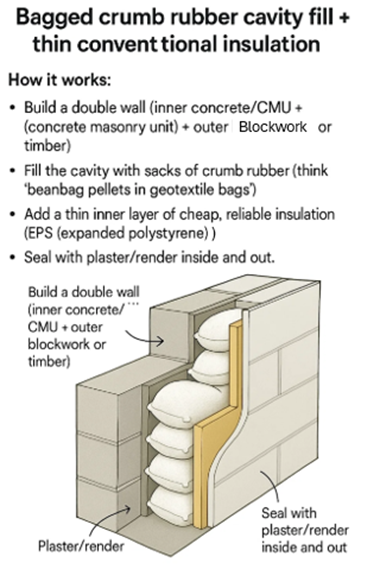
ReTyre Insulation Construction Diagram
Research Validation

Science Behind ReTyre

Aligned with Academic Research

"Independent research has shown that composites made from shredded tyres and polymers can significantly improve thermal insulation while reducing costs and environmental impact (Zakaria et al., 2018)."
Technical Feasibility

Validated as an effective material system for thermal insulation applications.

33% Cost Reduction Potential

Shredded tyre additives significantly lower polymer volume and total unit cost.

Verified Waste Recycling

Successfully diverts high-volume rubber waste from environmental degradation.

Note: ReTyre's specific formulation is currently in R&D. We reference this study as supporting evidence for the viability of tyre-based insulation systems, aligning our technical objectives with established academic findings.

Targeting The Bottom Line & The Planet

For Contractors

Investigating potential material cost advantages through the use of diverted waste streams. Designed to integrate into existing construction workflows.

For Councils

An alternative material to support social housing upgrades and net-zero targets within existing maintenance budgets.

For The Environment

Diverting non-biodegradable waste from landfill while assisting with residential carbon emission reduction.

UN Sustainability Goals: 11, 12, 13

Validation Milestones

Current Phase: Concept Validation (TRL 1-2)
Late 2024 / Early 2025

Concept & Design

University of Leeds SPARK recognition. Business model validation. Mission defined: redefining insulation through circular innovation.

2025 - 2026

R&D Validation Phase

Primary focus on exhaustive lab testing: fire safety (Euroclass), thermal conductivity targets (~0.05 W/m·K), and material durability. Securing technical validation for the composite formulation.

2027

Technical Innovation Target

Target submission for the IChemE Young Engineer Award (Innovation & Sustainability) to undergo formal industry-led peer review of the ReTyre material concept.

Post-Validation

Technical Certification & Pilots

Move toward self-certification and early-stage pilot partnerships once lab performance data is verified. Timeline and commercial milestones are dependent on technical validation results.

Technical Risk Assessment: Hover for Detail

Risk & Iteration Log (2025)

As a pre-validation venture, we track our technical hurdles with absolute transparency:

  • Fire Safety Risk: Current binder concentrations are undergoing iteration. We acknowledge that early formulations may fail Euroclass B/C fire testing; we are testing three different mineral binder ratios to mitigate this risk.
  • Moisture Management: We have not yet validated long-term moisture behavior in cavity environments. Developing a water-repellent geotextile casing is our secondary technical objective.
  • Installation Compatibility: The physical format (bagged units) requires verification for speed-of-install parity with mineral wool batts in high-volume social housing retrofits.

Current Phase: Material & Design Selection

Project Status: ReTyre is currently in the theoretical refinement stage (TRL 1-2). We are finalizing the material selection for our first composite formulation and mineral binding agents. Our primary objective is to progress from structural modelling to our first benchtop prototyping and physical sample trials (Target λ ≤ 0.05).

Investigation Methodology

Standardised Testing
  • Thermal: ISO 8301 (Heat Flow Meter)
  • Fire: BS EN ISO 11925-2 & BS EN 13823
  • Moisture: EN 12087 Water Absorption
Facilities & Success
  • University-affiliated materials laboratories
  • Target: Validated thermal parity with mineral wool (Euroclass B/C)

Validation Evidence

A live repository of laboratory data and certification progress.

Coming Soon

Internal benchtop baseline and external laboratory verification (Phase 1) is currently the primary technical objective.

The Team Behind ReTyre

A multi-disciplinary team combining finance, chemical engineering, and entrepreneurial execution.

Anthony Roy-Stanley

Anthony Roy-Stanley

Business Strategy & Finance

BSc International Business at the University of Leeds. Supporting financial planning, strategic decision-making, and market analysis to help evaluate opportunities, guide growth strategy, and inform key business decisions.

LinkedIn ↗
Bodhi Holland

Bodhi Holland

Technical Lead - Chemical & Environmental Engineering

Chemical Engineering with Environmental Engineering student at the University of Nottingham. Leading product development and sustainability considerations, with insight into material performance and environmental impact. Competing in the IChemE Young Engineer Award (Innovation & Sustainability 2027) using the ReTyre concept.

LinkedIn ↗
Rizlane Ouslimani

Rizlane Ouslimani

Technical & Network Development

Chemical Engineering student at the University of Leeds. Contributing to network development and providing technical expertise to support tyre innovation sustainability initiatives, engineering feasibility, and design decisions to optimise technical outcomes.

LinkedIn ↗

Business Model & Market

How ReTyre creates value - and who it serves.

Supply Chain

Short Term

Source tyres locally in Leeds, outsource shredding, keep minimal inventory, deliver directly to contractors using flexible suppliers.

Long Term

Integrate processing, secure multi-supplier contracts, automate production and distribute nationwide with established recycling partners.

Wedge Market: Social Housing

  • Primary Focus: UK Local Councils and Housing Associations managing large-scale, cost-sensitive retrofit portfolios.
  • Niche: Non-critical thermal upgrades for existing residential stock (e.g., partition walls and floor-void insulation).
  • Regulatory Fit: Targeting PAS 2035 retrofit standards once technical validation is complete.
  • Economic Objective: Targeting a potential 30% reduction in total material cost per m³ vs. traditional mineral wool.

Economic Moat Analysis

  • Material Focus: Targeting the technical requirements for non-critical and industrial insulation segments.
  • Structural Margin: Feedstock sourcing strategy designed to provide a defensible margin over mineral wool incumbents.
  • Technical Focus: Formulation R&D is currently prioritising fire safety standards and thermal conductivity testing metrics.
  • B2B Strategy: Direct procurement model targeting high-volume housing association maintenance contracts.

Financials & Risk

*Note: The following figures are early-stage target estimates.

Projected FocusLow-Cost Feedstock
Target SegmentsB2B Industrial
Feedstock Potential55M+ Tyres/Yr
Funding StatusOpen for R&D Support

Key Risks & Mitigations

  • Thermal conductivity target (~0.05 W/m·K) requires formulation iterations - addressed through systematic lab testing
  • Fire resistance concerns mitigated via mineral binders and fire-retardant additives
  • Market acceptance risk reduced by targeting cost-sensitive segments with certified test results

Industry Engagement

Validation and early stakeholder engagement proof points.

Project Recognition & Interest

  • University of Leeds SPARK Enterprise Bootcamp Winner - Concept Validation & Support
  • Strand Ventures Early-Stage Strategic Conversations
  • CEES Ambassador Day University of Leeds Selection
  • University of Nottingham Ingenuity Lab Member / Research Network

Professional Pilot Partnership

We are seeking strategic collaborations to accelerate the validation of our circular insulation system.

What We Are Testing

  • Thermal Conductivity (λ) Parity
  • Euroclass B/C Fire Performance
  • Long-term Moisture Durability

What We Need

  • Specialist Laboratory Access
  • Pre-Seed & Grant Funding
  • Non-Critical Pilot Site Access

The Partner Value

  • Early Access to Cost-Reduction Data
  • Validated ESG & Circularity Reporting
  • Priority Access to Local Pilot Units